

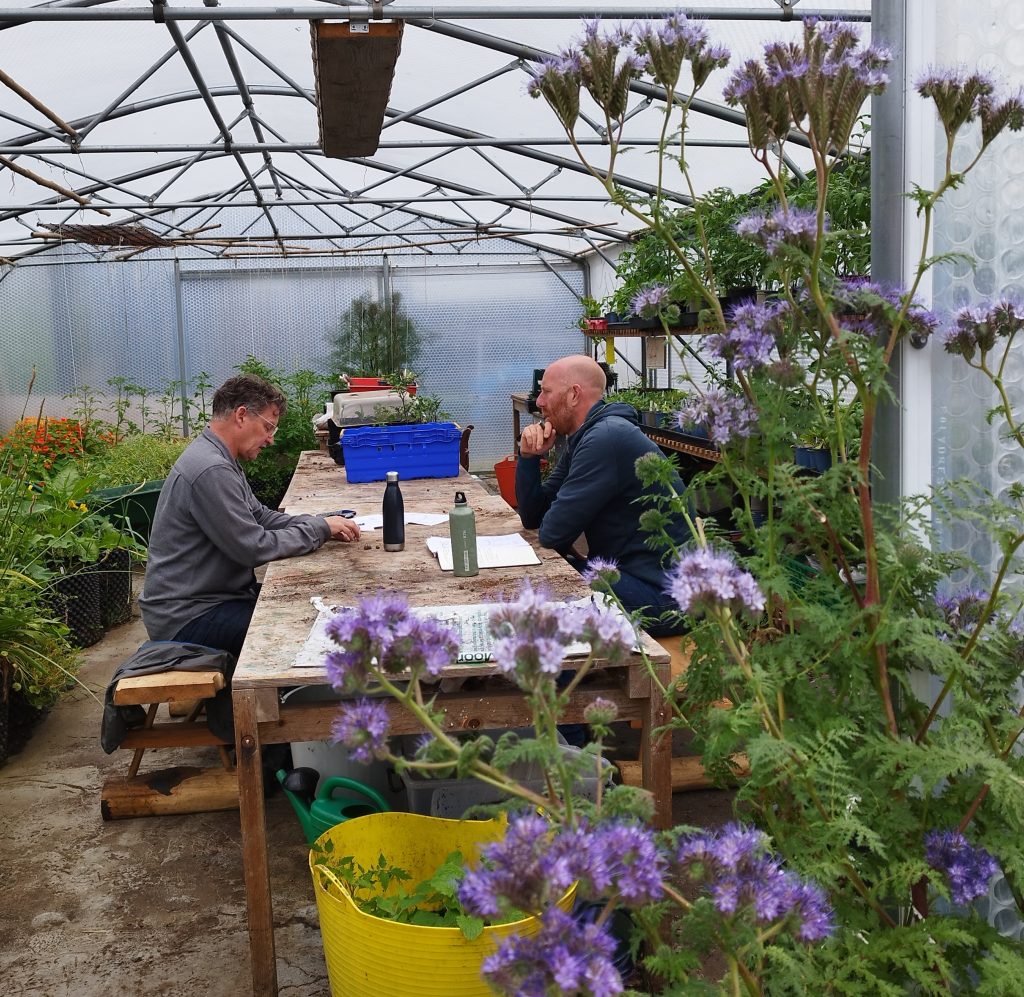
This reflection was written in the midst of delivering the first days of Wise Goose Foundations course. It’s part of an ongoing series of articles exploring goals, meaning, growth and transition, and what coaching can offer when achievement alone doesn’t quite answer the deeper questions people are carrying.
The first two days of the new Wise Goose Foundations cohort, our five-day introduction to coaching, are complete.
I’ve been working towards the launch for months, checking that the programme design is still current, marketing (not my greatest love or strength), making sure the admin is taken care of, then, at last, the exciting, fun bit – welcoming a new group, holding the space, teaching, and seeing skills grow and trust begin to form in the room.
One of the things I love most about this particular training is that after two rich and full days participants can walk out of the door ready to start coaching their peers.
By any reasonable measure, the goal has been achieved.
And yet, in the lull that follows, I’m noticing something familiar.
Not disappointment.
Not dissatisfaction.
Just a subtle sense of “and now what?”
The moment after the goal is met
We often talk about the process of working towards a goal; the effort, the challenges, the focus, the stretch.
We talk less about the moment after the goal has been reached.
On Monday evening, after we’d closed the gate to the Paper Garden and I walked towards Canada Water it felt like a long slow exhale:
- The structure that has been guiding actions loosens.
- The energy changes, it subsides and settles. It’s similar to the feeling when I’ve climbed a really steep hill – you reach the top, sense your heart rate slowing and breathe deeply taking in the view.
- There’s space to notice other things that have been carrying on in the background while our focus was elsewhere – for me it’s the weeds that have been taking over my allotment, and a creative writing project that’s languishing.
For many people, this moment brings satisfaction and relief.
For others, it brings something more ambiguous:
- a slight emptiness
- a sense of anticlimax
- the realisation that there’s another hill to climb
- or the realisation that achievement didn’t quite answer a deeper question it was standing in for
It’s often a bit of both. This doesn’t mean the goal was wrong.
It means the goal was doing more than one job.
When goals carry more weight than they can hold
As I look back on these first days of Foundations, I’m very aware that for some participants, starting this course has also been a long‑held goal.
They’ve invested time, money, hope, and energy.
And alongside the excitement of beginning, for a few, there may be a subtle undercurrent, a deeper question of what this step is really meant to resolve for them.
Goals often carry unspoken or unconscious expectations:
- This will make my future feel clearer.
- This will settle my uncertainty.
- This will finally align work and life.
Sometimes they do.
And sometimes, achieving the goal simply reveals that another layer of growth is asking for attention.
Two kinds of growth, pulling in different directions
There’s a pattern I see again and again in coaching and training.
One part of us is oriented towards:
- action
- achievement
- competence
- making things happen in the world
This part is essential. It gets things done.
Another part of us is oriented towards:
- meaning
- integrity
- alignment
- living in a way that feels inwardly coherent
This part is often easier to ignore.
For long periods of life, these two can move in the same direction.
But at certain moments, particularly around transitions , endings or new beginnings, they can pull against each other.
That tension doesn’t mean something has gone wrong.
It means growth is no longer only about answering the call of one side.
Why “empty goals” aren’t actually empty
When people talk about goals feeling empty, it’s rarely because they don’t care and it’s rarely because the goal lacked value or purpose.
It’s because the goal has been reached, and the deeper question it was pointing towards is still unanswered.
Questions like:
- Who am I becoming through this?
- What really matters now?
- How do I live this, not just achieve it?
These questions can feel uncomfortable, especially in professional contexts that reward clarity, drive and momentum. The discomfort that can follow achievement is often not failure, but a signal that meaning and identity are asking to catch up with action.
They’re not distractions from progress.
They’re invitations to a different quality of growth.
What I’m noticing as the Foundations course unfolds
As I reflect on these first days, the learning, the trust‑building, the tentative confidence beginning to emerge, I’m reminded that coach training can be a paradoxical art. It includes the skills, techniques and frameworks and it’s also about learning to stay present when:
- achievement doesn’t bring immediate resolution
- there’s a discomfort or struggle to align valued ways of working (perhaps from a therapeutic or advice giving/consultancy modality) with a coaching approach
- new questions appear just as old ones are answered
This is as true for facilitators as it is for participants.
Living the question, not rushing past it
The temptation, when a goal is achieved, is to quickly set the next one.
Sometimes that’s exactly right.
And sometimes, a more impactful move is to pause and notice what the achievement has made visible.
Because the emptiness that can follow a goal isn’t a failure of ambition.
It’s often a sign that life is asking us to bring together what we do and who we are becoming, rather than letting one stand in for the other. It’s a question that needs us to be with ourselves and not rush towards the next goal, the next project or the next action. This is a question that shows up not just in coaching, but in many, many forms of professional and personal transition.
Questions like these sit at the heart of our coach training at Wise Goose where we work not only with skills and techniques, but with the inner work of transition, learning how to stay present when new questions emerge just as old ones are answered.
Reflective question:
Where in your own work or life have you reached a goal, only to discover a deeper question waiting underneath?
This article is part of our reflections on coaching, growth and transition. It also appears on my ‘Helen Sieroda’ Linkedin articles page. You might also like:
– Why Feeling Stuck Is Often a Meaning Problem, Not a Motivation One
– What It Really Means to Stay With Ambivalence
– Coaching When There Are No Easy Answers