

This reflection comes from my work in coaching and coach training at Wise Goose, and from noticing how ambivalence shows up again and again, not as a problem, but as a pointer towards greater authenticity.
May has always been my favourite month in Devon.
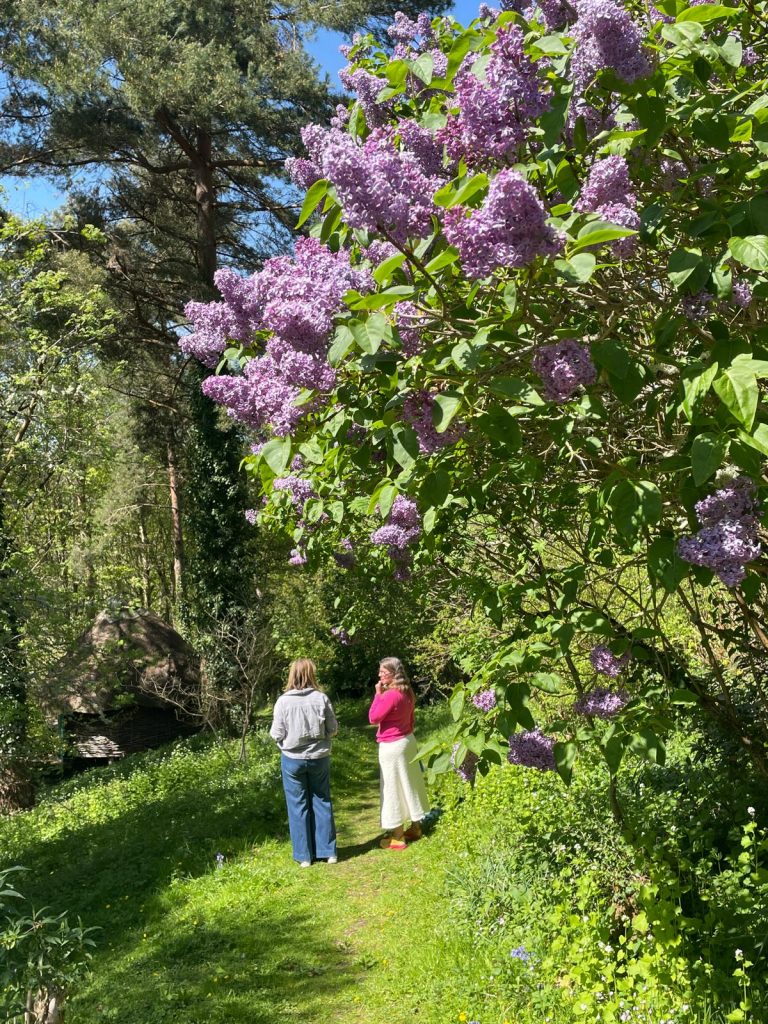
The hedgerows are extravagant, cow parsley frothing at the edges, hawthorn bursting into white; bluebells and lilac and red campion. And the clematis twining higher every year, covering the dying weeping ash with blooms. Everything feels alive. There’s a sense of promise without urgency.
At this time of year, I notice a familiar pull.
Part of me wants to be in the garden, hands in the soil, noticing what’s emerging, letting the days unfold at a slower pace. Another part of me feels equally drawn to work, teaching, writing, shaping the next stages of our programmes, responding to what’s emerging. I want to get creative and imagine new projects, new collaborations and new thinking.
If I neglect the garden, I feel guilty as brambles and bindweed begin to take over.
If I neglect the work, I feel I’m losing touch with an important part of myself – and feel guilty there too.
Sometimes I seesaw between the two. Sometimes I get caught in the middle and sit and gaze and do nothing.
Both pulls feel real.
Both matter.
And neither is wrong.
What’s uncomfortable is not the pulls themselves but standing in the space between them. This is ambivalence, not as an abstract idea, but as lived experience.
Why ambivalence makes us uncomfortable
In many professional contexts, ambivalence is treated as a weakness.
We’re encouraged to:
- make clear choices
- commit fully
- focus our energy in one direction
So, when we feel torn, we often assume something has gone wrong. That we’re procrastinating, lacking clarity, or failing to prioritise properly.
But ambivalence isn’t the absence of direction.
It’s the presence of more than one truth and both have meaning.
And that’s why it can feel so unsettling.
The mistake of rushing ourselves
As the training programme begins to settle into its rhythm, I’m noticing how often ambivalence shows up for new coaches, and how quickly people try to push past it.
They want to know:
- Am I doing this right?
- Should I be more confident by now?
- Why do I feel both excited and unsure?
From the outside, this can look like hesitation.
From the inside, it’s often something more nuanced.
Learning to coach, like learning to live well, involves holding competing pulls:
- structure and openness
- competence and humility
- action and reflection
If we rush ourselves to resolve these tensions too quickly, we often lose something essential.
What ambivalence is really telling us
Whenever I meet deep competing pulls, I try to remind myself of the Latin root of the word – ambi meaning both, and valere meaning strength, worth or power. Valour, value, valid, valiant; there’s beauty and timeless strength hiding in the roots of the word.
On a more practical level, when I pause and listen, whether to myself, to participants, or to clients, ambivalence often turns out to be information.
It tells us:
- that values are in play
- that identities and identifications are shifting
- that an old way of organising life or work is loosening
The pull of the garden and the pull of work aren’t competing enemies. They’re both expressions of care, for life, for growth, for contribution.
The work isn’t to choose one and silence the other.
The work is to stay present long enough for a wiser relationship between them to emerge.
Coaching doesn’t remove ambivalence; it can teach us to stay
One of the things coaching invites, and that we try to model when training Wise Goose coaches, is a different response to inner conflict.
Instead of asking: How do I get rid of this tension?
We begin to ask:
- What matters on each side?
- What is each pull trying to protect or express?
- What happens if I don’t rush to decide?
It takes courage to stay with mixed feelings without collapsing into action or avoidance – to remain in that in‑between space long enough for something wiser to emerge.
But over time, something else becomes possible, maybe not a neat solution, but a deeper sense of integrity.
For me this is where sitting and gazing can be exactly what’s needed. Seek no answer. Search for no meaning. Ignore my own advice, Ignore the questions I just wrote above. Just allow things to rest a while, to remain unsolved. Unfinished. This isn’t meditation and it isn’t mindfulness. It’s not laziness either – though for years I thought I was being lazy. It’s something else. Something that doesn’t want to be ‘worded’.
Living with the season you’re in
May won’t last forever. Neither will the intensity of launching programmes, holding training spaces, or meeting deadlines.
Part of maturity, in work and in life, is learning to recognise the season you’re in, without insisting it should be something else.
Right now, for me, that includes:
- enjoying the hedgerows in bloom
- feeling the pull of the garden; the joy of sowing and planting, and weeding.
- complaining about the coolness of the temperature this May, which includes a nagging anxiety about what the weather might be telling me about the climate.
- and continuing to show up fully for the work that matters whether that be coaching, supervision or training or something new and unexpected.
Not by resolving the tension between them, but by letting them inform one another. And sometimes this happens by doing neither and both at the same time as I sit with a cup of coffee, breathing sweet May air, listening to birdsong.
A different way of understanding progress
Ambivalence doesn’t have to mean you’re stuck.
It often means you’re awake to the complexity of what you care about.
And that’s not a problem to fix.
It’s a place to stand, to be with, until the next step becomes clearer in its own time.
Reflective question:
Where in your own life or work are you feeling two pulls at once – and what might change if you treated that tension as meaningful rather than something to overcome?
This piece is part of an ongoing series of practice‑based writing from Wise Goose, exploring coaching, meaning, ambivalence and transition as they show up in real work and real lives.
These reflections grow out of our coach training, leadership coaching and supervision work, where we focus not on fixing complexity, but on learning how to stay present with it.