
This week, I’ll be working with a training group on their final meeting of their Wise Goose Limited Advanced Diploma journey.
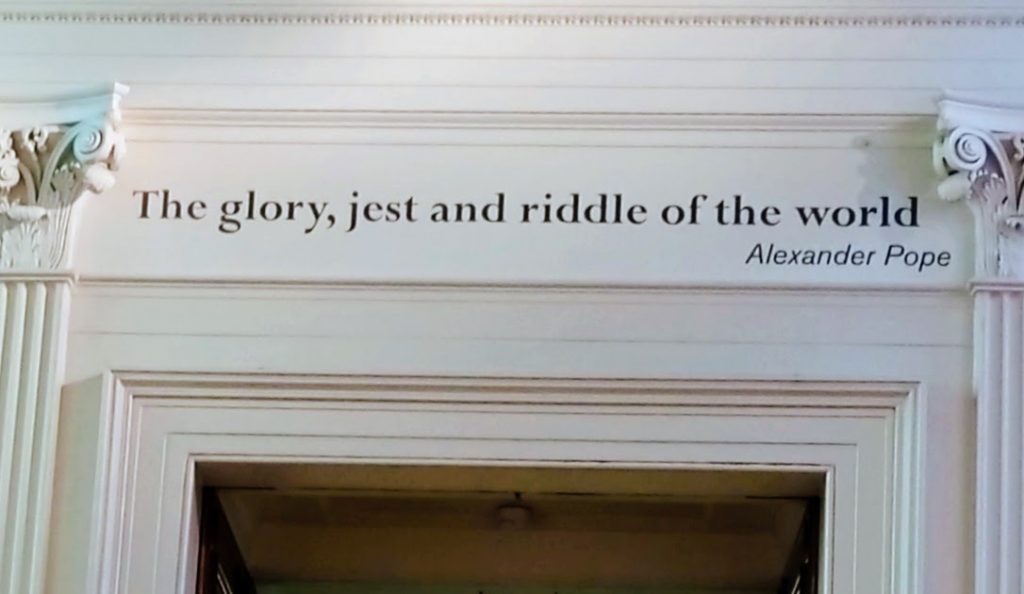
As part of this are spending a day at the British Museum. I took the photo above there last year. I think this quote from Alexander Pope fits well with the topic of this weeks post.
The glory, jest and riddle of the world.
Why the British Museum? The purpose of the visit is experiment with shifting perspectives.
The invitation is for students to ‘locate’ themselves in a wider world. To wander and wonder and practice coaching, exploring how they are part of something larger.
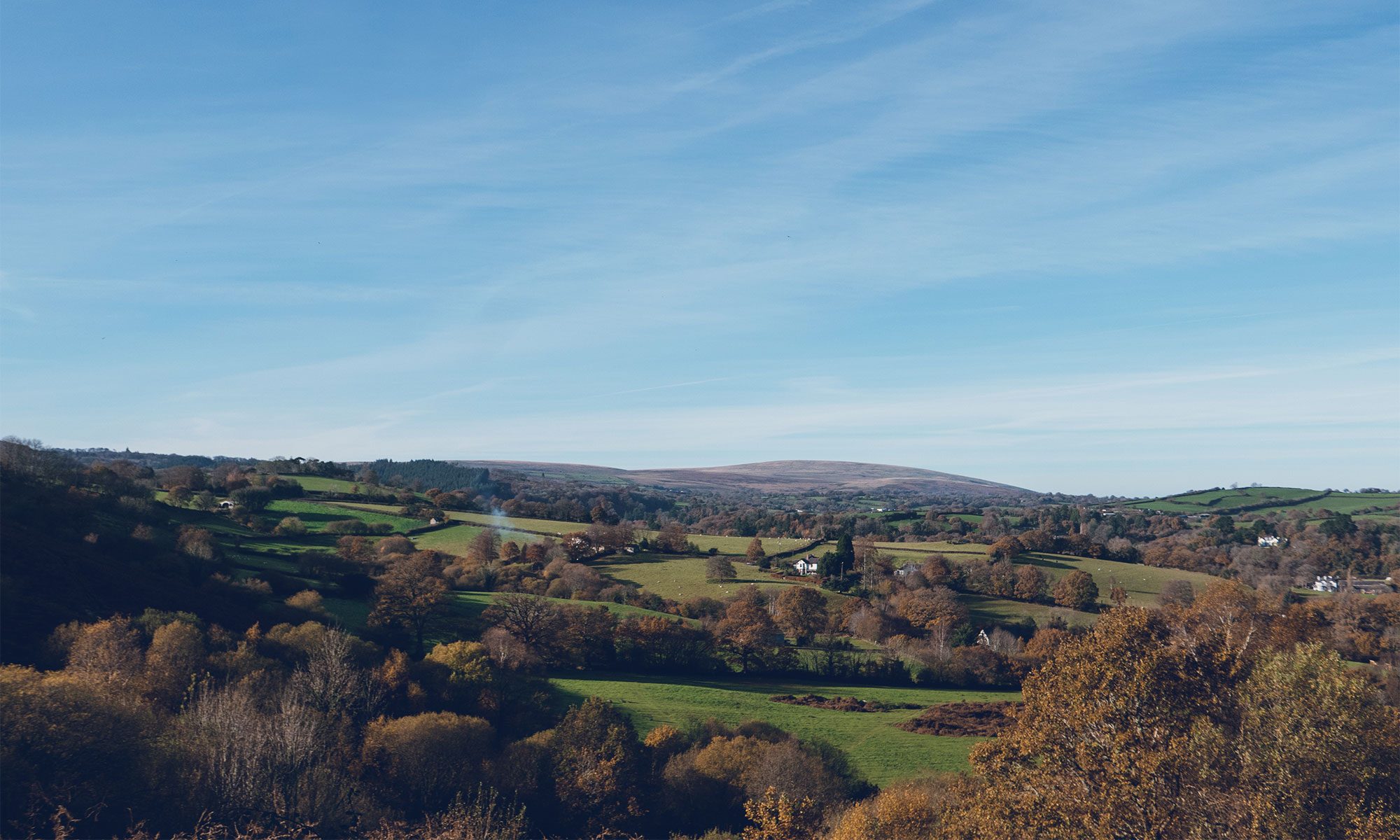
I could have chosen somewhere else, an art gallery, the Science or Natural History Museums. In the past when we held this topic in Devon we went onto Dartmoor. The point is that any of these could work.
We’ve been working together for a year. On the one hand I’m looking forward to the completion, the celebration, the satisfaction of a job well done and the spaciousness that follows letting go. On the other hand I don’t want to let go, I want to continue the journey with these amazing people who I have come to know.
There’s a particular quality at moments like this. On the surface, something is finishing:
- the taught elements are complete
- the structure that has held the learning is loosening
- portfolios, assessments, appreciations and certifications are in view
And yet, underneath that, something else is beginning. Not a new programme but a different relationship to development itself.
Earlier in professional life, development often looks like accumulation. More knowledge. More skill. More confidence. More competence.
That kind of growth is essential. It gives us solidity and credibility.
But at a certain point, often somewhere towards the end of a long training journey, like this one, another experience surfaces. This is the sense that:
- knowing more doesn’t automatically make things simpler
- competence doesn’t remove uncertainty or complexity
- and insight doesn’t always dissolve tension
This can feel unsettling, especially for people who are capable, reflective, and used to mastering complexity.
Some new graduates react to this by immediately reaching for the next programme, more input, more certainty and reassuring structures to bring security and fill the gap.
But that feeling of not knowing, of uncertainty may be signalling something worth staying with for a while.
From fixing problems to holding paradox
One of the shifts I often notice at this stage is a change in what people are working with. Earlier, the focus tends to be on:
- finding the right intervention or framework
- choosing the right question
- Clarifying goals, helping clients move forward, evaluating outcomes
Later, something more subtle can come into view. Situations where:
- two values matter deeply and neither can be sacrificed
- progress involves staying present rather than moving on
These aren’t problems to solve.
They are paradoxes to live with.
Why paradox marks a new stage of development
In earlier articles I’ve looked at how paradox is often misunderstood as confusion or lack of clarity.
In fact, an ability to recognise and work with paradox usually appears after clarity has been worked hard for. It emerges when someone can:
- see more than one side of a situation
- tolerate contradiction without panic
- resist the urge to collapse complexity into choosing one option too quickly
This requires deeper engagement. Where coach and the client are not standing outside, but inhabiting an issue more fully; attentive to tensions, values, relationships and exploring unintended consequences of actions. I’m thinking here about the capacity to hold:
- action and restraint
- authority and humility
- engagement and letting go
These are living tensions and developing this ability to shift perspectives develops over time.
Although I recognise these pushes and pulls more readily as I grow as a coach and a trainer, I also make miss-steps. I may have been accredited as a ‘Master’ coach but this is an art I’m still learning to master!
Coaching at this level looks different
As I prepare to complete the journey with this group of coaches next week, I know that as they reach this stage, their work will change in subtle and significant ways. They may:
- intervene less, but with greater precision
- speak less, but listen more deeply
- feel less pressure to be helpful, and more commitment to be honest
They become less attached to delivering outcomes, and more attentive to process.
This is a shift from doing coaching to being a coach, where presence itself becomes part of the work.
An ending that doesn’t close things down
As this diploma journey comes to an end, what matters most to me isn’t that people feel finished. I want them to leave with:
- greater trust that their work is about not knowing everything
- a more generous relationship with uncertainty and complexity
- and a willingness to let go of being an expert and let development continue unfolding
The play of paradox, once noticed, doesn’t go away. Instead it becomes part of how we see, and how we stand, in the world.
A lifelong practice
There’s something humbling about this stage of learning. There is no final ‘mastery’; no point at which tension resolves for ever; no destination or arrival that closes the journey.
Instead, there is an ongoing practice:
- of staying present
- of allowing growth to be shaped by what is emerging rather than driven by certainty
- of holding contradictions with integrity
- and remembering that part of the practice is recognising when we can’t quite manage the stretch at this time, or in this context.
That may not sound like a neat ending.
But it is, I think, the most honest beginning available.
Reflective question: Where in your own development might paradox be inviting you not to resolve things, but to grow your capacity to hold them?
This article has also been published under Helen Sieroda’s Linkedin articles.